Optimizing Series Inductance in Dual Active Bridge Converters with Infinite-Width Bayesian Neural Networks
Partner research published by the Advanced Power Electronics Lab at National Taiwan University of Science and Technology (NTUST), combining SIMBA circuit simulation with ANSYS Maxwell electromagnetic FEA inside an automated Bayesian optimization loop.
Why this paper matters
Dual Active Bridge (DAB) converters are widely used in EV charging, renewable energy, and energy storage systems because they combine galvanic isolation, bidirectional power flow, and soft-switching capability. In practice, the series inductance (L_s) is one of the most sensitive design choices: it shapes power transfer, peak and RMS currents, magnetics loss, and semiconductor switching loss.
Selecting (L_s) by hand or with dense parameter sweeps quickly becomes expensive when each candidate requires circuit simulation and electromagnetic finite-element analysis (FEA). This partner paper shows how Bayesian optimization with an Infinite-Width Bayesian Neural Network (I-BNN) can find a high-efficiency design with far fewer evaluations, using SIMBA for the converter circuit and ANSYS Maxwell for the magnetics.
About the partner authors
This article was written by research partners at the Advanced Power Electronics Lab, National Taiwan University of Science and Technology (NTUST):
- Hsiao-Chin Yen
- Nguyen Tan Tung
- Man-Hay Pong
- Huang-Jen Chiu
It was presented at the 46th Symposium on Electrical Power Engineering & 22nd Taiwan Power Electronics Conference (Tainan / Changhua, November 14–15, 2025).
SIMBA is proud to support partner research that advances automated power-electronics design. The authors acknowledge SIMBA for power-electronics simulation software and technical support.
What the paper proposes
The partners formulate a constrained design problem for the DAB series inductor, then solve it with Bayesian optimization using an I-BNN surrogate instead of a conventional Gaussian Process kernel.
The workflow has three layers:
- Design-space definition — topology knowledge and converter equations define feasible ranges for switching frequency and air-gap length.
- Loss-aware objective — maximize converter efficiency under those constraints.
- Sample-efficient optimization — an I-BNN surrogate guides acquisition so each new candidate is more likely to improve efficiency.
The hybrid simulation stack is explicit in the paper:
- SIMBA — circuit-level DAB model, automated through the Python API
- ANSYS Maxwell — FEA of the series inductor and transformer (inductance, leakage / magnetizing inductance, core loss, copper loss), including 1/4-symmetry models to cut simulation time
- BoTorch / PyTorch — Bayesian optimization with the Infinite-Width BNN surrogate
That SIMBA + ANSYS Maxwell pairing is what makes each optimization iteration physically meaningful: circuit loss and magnetics loss are evaluated together before the surrogate proposes the next design point.
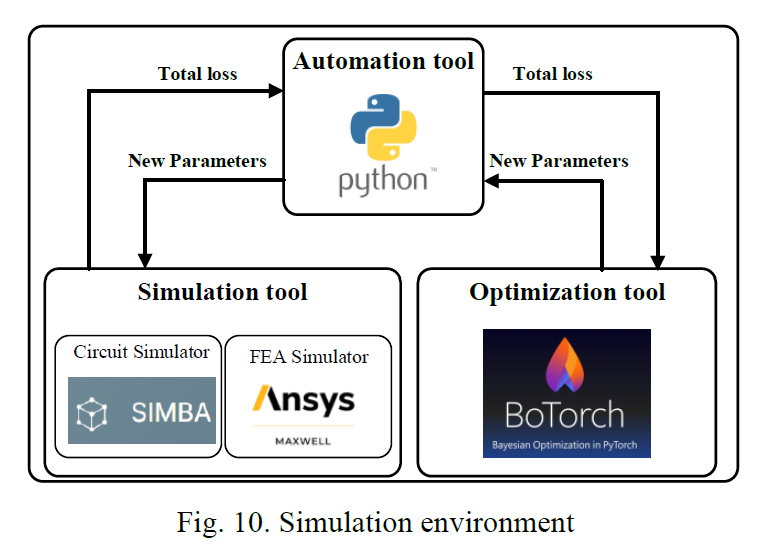
Figure: simulation environment used in the partner paper — circuit simulator, FEA tool, optimization stack, and Python automation.
Converter specification used in the study
| Parameter | Value |
|---|---|
| Topology | Dual Active Bridge (DAB) |
| Rated power | 5 kW |
| Input voltage | 800 V |
| Output voltage | 400 V |
| Switching frequency range | 100–200 kHz |
| Control | Single Phase Shift (SPS) |
The optimization focuses on series inductance through two decision variables:
- air-gap length (l_g \in [0.5, 5.5]\,\mathrm{mm})
- switching frequency (F_{sw} \in [100, 200]\,\mathrm{kHz})
Turns are fixed from saturation / window constraints, and the feasible (L_s) band accounts for transformer leakage inductance. The air-gap sweep that maps gap length to series inductance is performed with ANSYS Maxwell, so only electromagnetically valid inductor designs enter the Bayesian loop.
Key results
Bayesian optimization with the I-BNN surrogate identifies a strong operating point early in the loop:
| Iteration | Air gap (l_g) | (F_{sw}) | Simulated efficiency |
|---|---|---|---|
| Init | 3.5 mm | 150 kHz | 97.500% |
| 4 (best) | 3.4 mm | 100 kHz | 97.735% |
That best design was implemented on a 5 kW hardware prototype. Measured peak efficiency reached 98.38%.
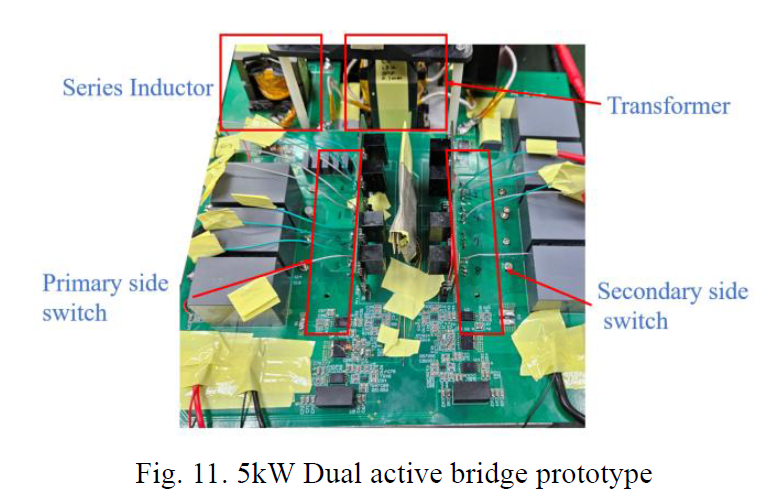
Figure: 5 kW DAB prototype used to validate the optimized series-inductance design.
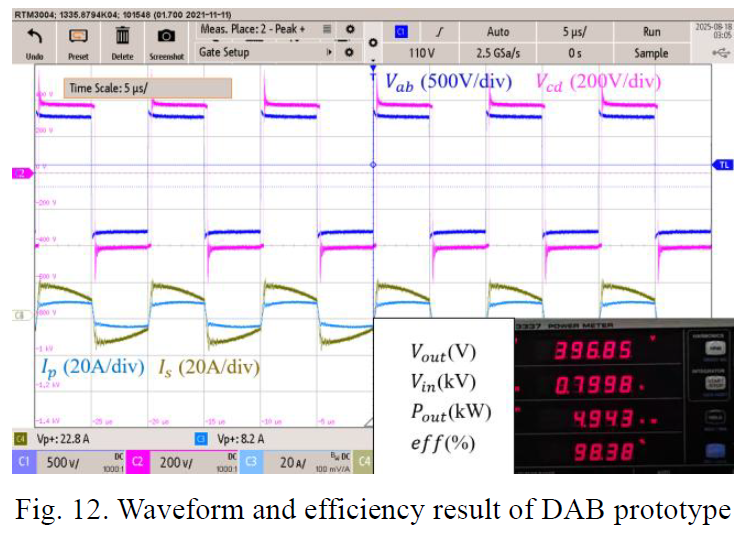
Figure: operating waveforms and efficiency results on the hardware prototype (peak efficiency 98.38%).
Why SIMBA and ANSYS Maxwell fit this workflow
The paper couples two complementary tools inside one Python automation loop:
SIMBA (circuit simulation)
- DAB schematic setup and control (SPS)
- repeated converter evaluations for candidate designs
- loss-aware metrics returned to the optimizer
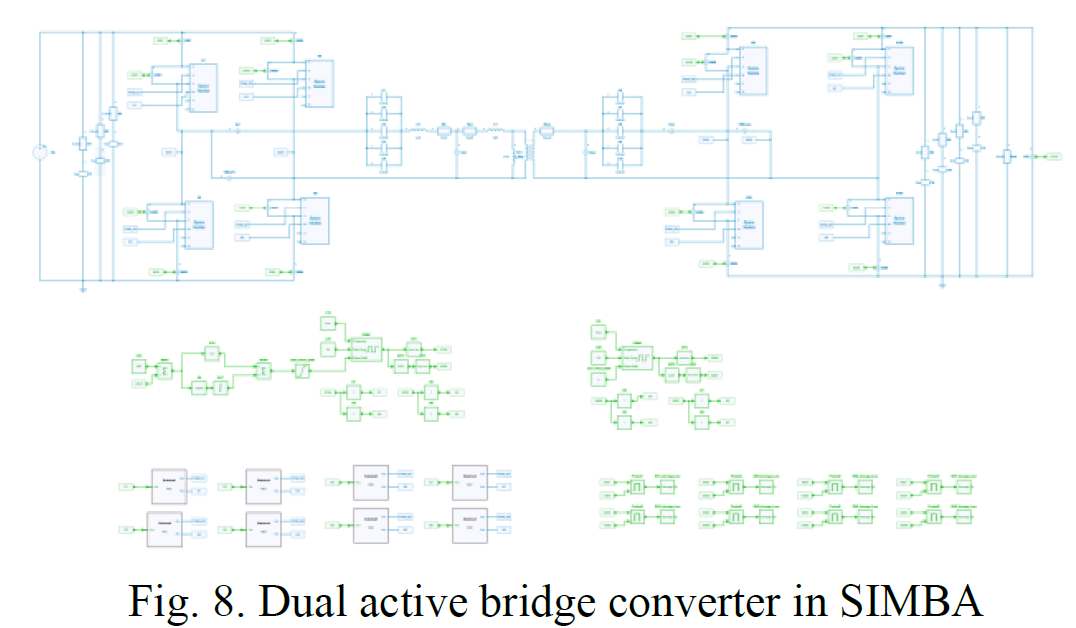
Figure: Dual Active Bridge converter in SIMBA, used as the circuit-level evaluation engine inside the optimization loop.
ANSYS Maxwell (electromagnetic FEA)
- series-inductor inductance vs air-gap mapping
- transformer leakage and magnetizing inductance
- core loss and copper loss for both magnetic devices
- 1/4-symmetry models to accelerate FEA iterations
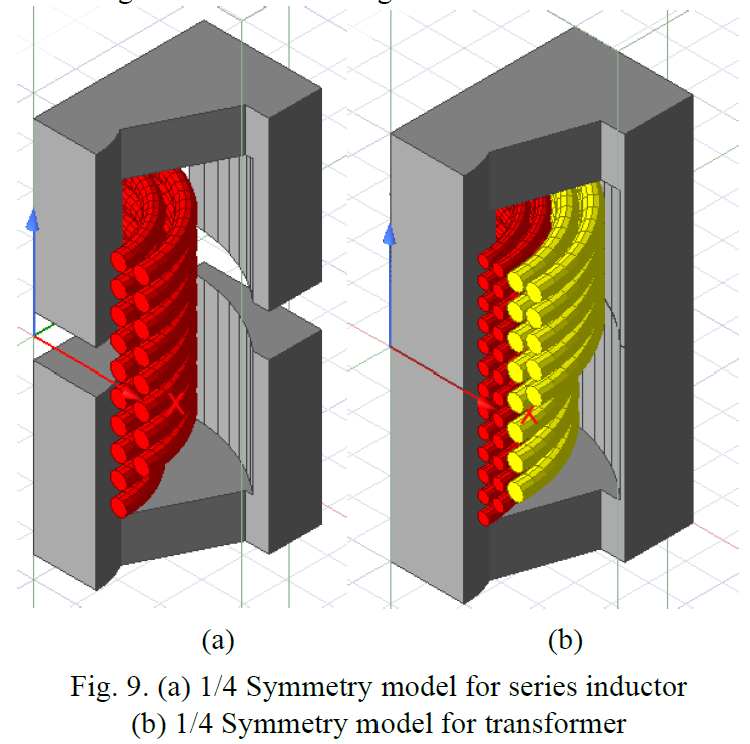
Figure: ANSYS Maxwell 1/4-symmetry models for the series inductor and transformer, used to extract inductance and magnetic losses.
Together, SIMBA + ANSYS Maxwell turn a black-box efficiency objective into a practical design-space exploration workflow: equations define the feasible region, FEA constrains magnetics physics, circuit simulation ranks converter efficiency, and Bayesian optimization concentrates evaluations where efficiency improves.
Explore related SIMBA capabilities:
Who should read this paper
This publication is useful if you are working on:
- DAB / isolated bidirectional DC-DC design
- series inductance and magnetics trade-offs
- ANSYS Maxwell FEA for inductors and transformers
- Bayesian optimization or surrogate models for expensive simulations
- hybrid SIMBA + ANSYS Maxwell (circuit + FEA) design automation
- EV charging or high-power energy conversion stages
Download and citation
Suggested citation:
H.-C. Yen, N. T. Tung, M.-H. Pong, and H.-J. Chiu, “Optimization of Series Inductance in Dual Active Bridge Converters Using Infinite-Width Bayesian Neural Networks,” 46th Symposium on Electrical Power Engineering & 22nd Taiwan Power Electronics Conference, November 2025.
Key takeaways
- Series inductance in a DAB converter is a high-impact, multi-constrained design variable, not a single textbook choice.
- Infinite-width Bayesian neural networks can serve as expressive surrogates for Bayesian optimization when each evaluation is costly.
- A hybrid SIMBA + ANSYS Maxwell + Python loop made the optimization practical: circuit behavior and magnetics physics are evaluated together.
- The optimized design reached 97.735% in simulation and 98.38% peak efficiency on a 5 kW prototype.
About this publication
This page highlights partner research that used SIMBA and ANSYS Maxwell in a real academic design-automation workflow. The scientific content belongs to the NTUST authors listed above. SIMBA publishes this summary to help engineers discover the paper and understand how circuit simulation, electromagnetic FEA, and Bayesian optimization fit together in modern power-electronics design.


