A New Method for Power Circuit Design Automation by Incorporating Discrete Components into Bayesian Optimization
Partner research from the Advanced Power Electronics Lab at National Taiwan University of Science and Technology (NTUST). This page is the English summary; a Traditional Chinese version is also available.
Why this paper matters
Power-converter design is rarely a continuous math problem. In real projects, engineers choose commercial MOSFETs, magnetics, and capacitors from datasheets. Those choices are discrete, nonlinear, and expensive to evaluate with full circuit simulation.
This partner paper shows how Bayesian Optimization (BO) can search that discrete design space efficiently. Using a Gaussian Process (GP) surrogate with normalization and distance metrics over datasheet parameters, the method converges to >98% efficiency on a 3.3 kW buck converter in only about 30 SIMBA simulations.
About the partner authors
Written by research partners at NTUST:
- Nguyen Tan Tung
- Chao-Wei Tsai
- Man-Hay Pong
Presented at the 46th Symposium on Electrical Power Engineering & 22nd Taiwan Power Electronics Conference (Changhua, Taiwan, November 14–15, 2025).
Original title: 一種將離散元件納入貝葉斯優化以實現電源電路設計自動化的新方法.
What the paper proposes
The core challenge is that Bayesian Optimization usually assumes continuous variables, while real power designs use part numbers. The partners therefore:
- Build a discrete component dictionary from manufacturer datasheets (Infineon, Wolfspeed, ST, …).
- Encode MOSFET, frequency, and inductor turns into searchable indices.
- Apply normalization + distance metrics so datasheet parameters such as (R_{ds(on)}), capacitances, and threshold voltage can be compared fairly.
- Use a GP surrogate + Expected Improvement (EI) acquisition function to pick the next candidate.
- Evaluate each candidate with SIMBA circuit simulation, including MOSFET, magnetics, and capacitor losses.
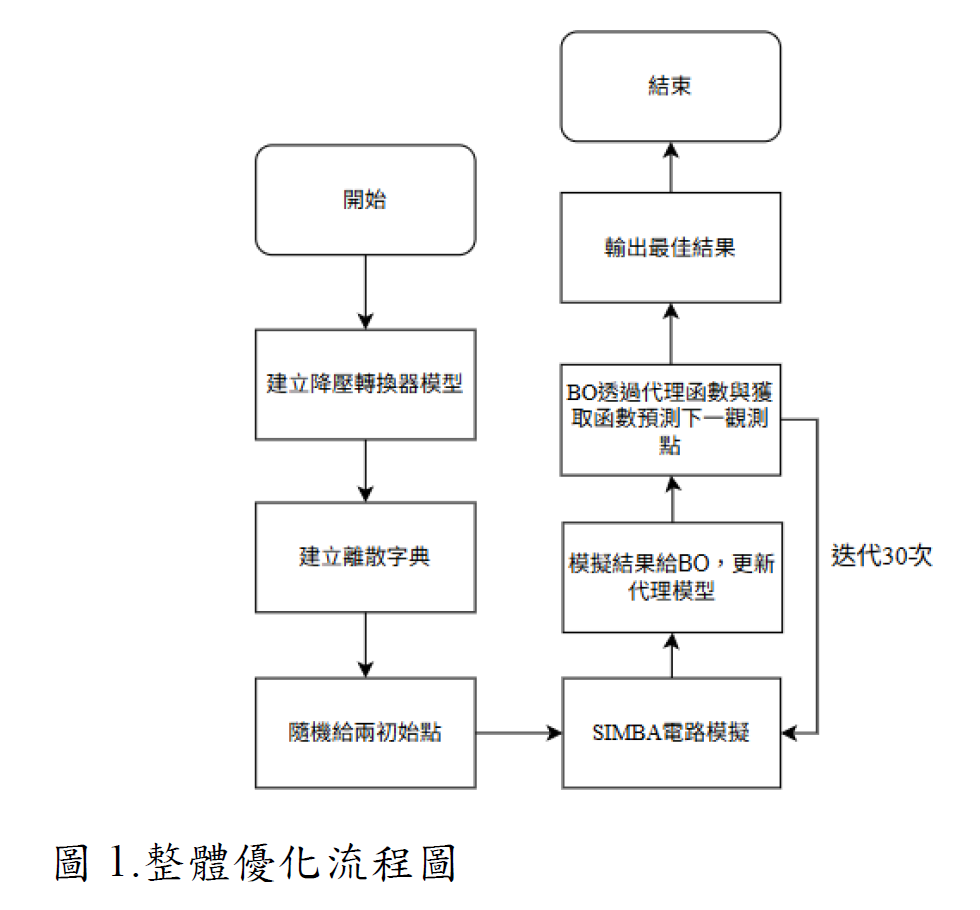
Figure: overall optimization flow — BO proposes candidates, SIMBA evaluates efficiency, and the GP surrogate is updated iteratively.
Converter case study
| Parameter | Value |
|---|---|
| Topology | Synchronous buck (closed-loop) |
| Rated power | 3.3 kW |
| Input voltage | 400 V |
| Output voltage | 220 V |
| Output current | 15 A |
| Frequency options | 60–200 kHz (8 values) |
| MOSFET catalog | 20 commercial devices |
| Inductor turns options | 21–32 turns (12 values) |
| Combinatorial space | 1,920 designs |
Loss modeling covers:
- MOSFET conduction and switching loss from datasheet capacitances, transfer/output curves, (R_g), and body-diode recovery
- inductor copper loss (including Litz geometry) and core loss via a Generalized Steinmetz Equation (GSE) with temperature segments
- DC-bias correction of effective permeability
- capacitor ESR loss
Key results
Across ~30 BO iterations, the optimizer focuses on high-efficiency regions and drives Expected Improvement toward zero.
One strong design identified during the loop:
| Item | Value |
|---|---|
| MOSFET | C3M0045065K |
| Switching frequency | 60 kHz |
| Inductor turns | 32 |
| Simulated efficiency | 98.38% |
That result is obtained without exhaustively simulating all 1,920 combinations — the point of discrete-aware Bayesian Optimization.
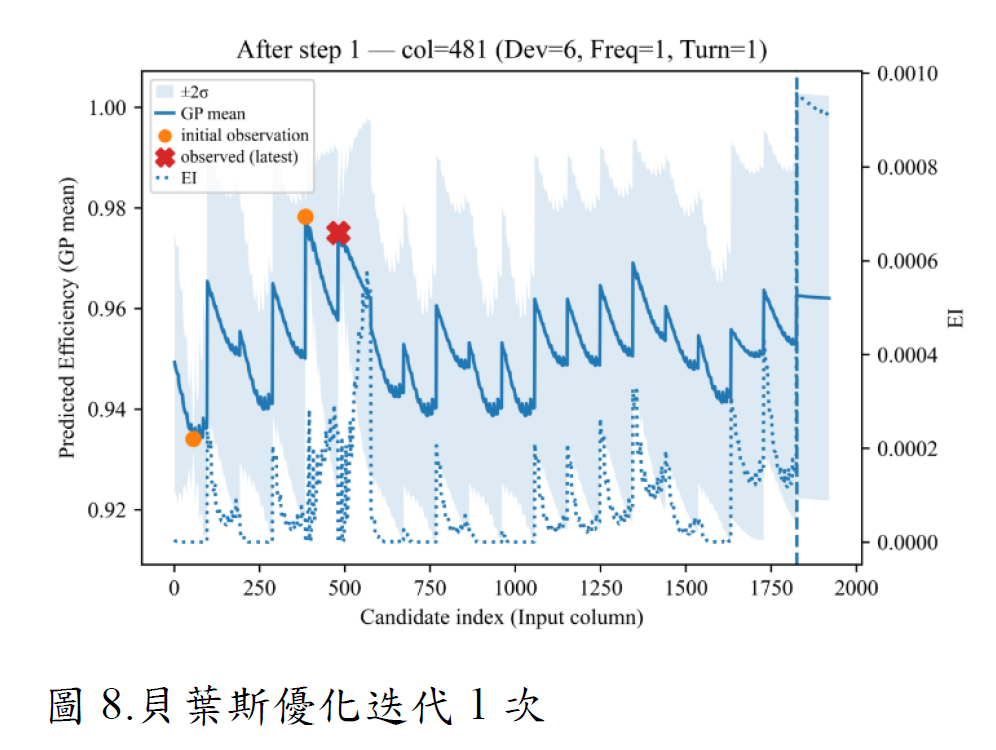
Figure: BO iteration 1 — the GP surrogate starts with high uncertainty and broad Expected Improvement peaks.
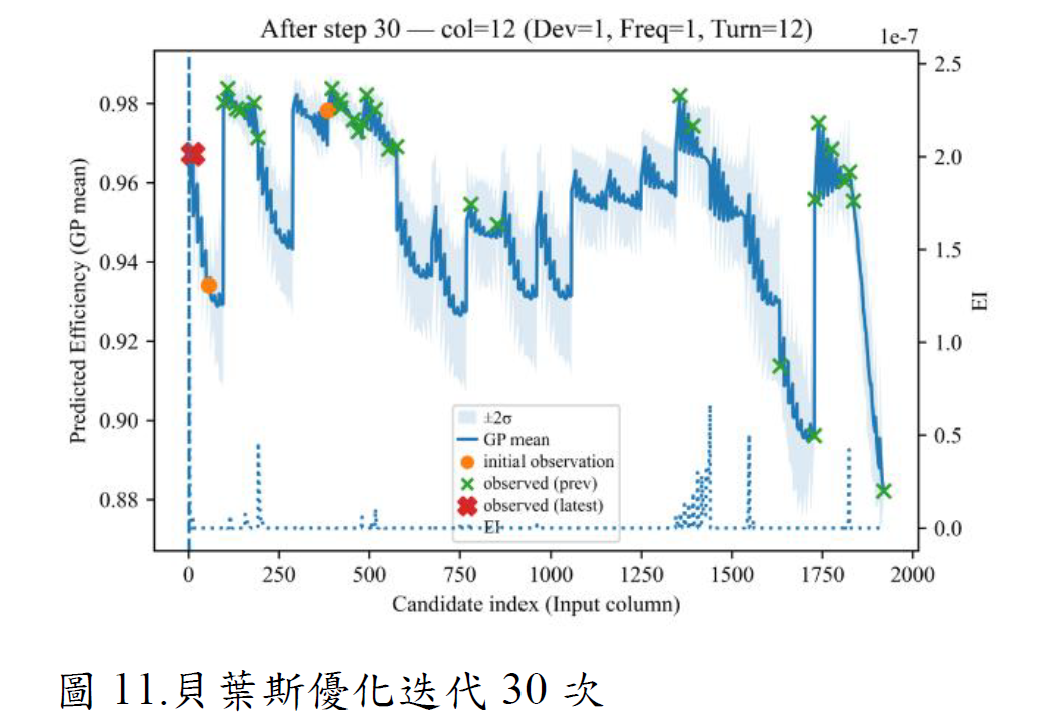
Figure: BO iteration 30 — the surrogate converges and EI approaches zero near the best design.
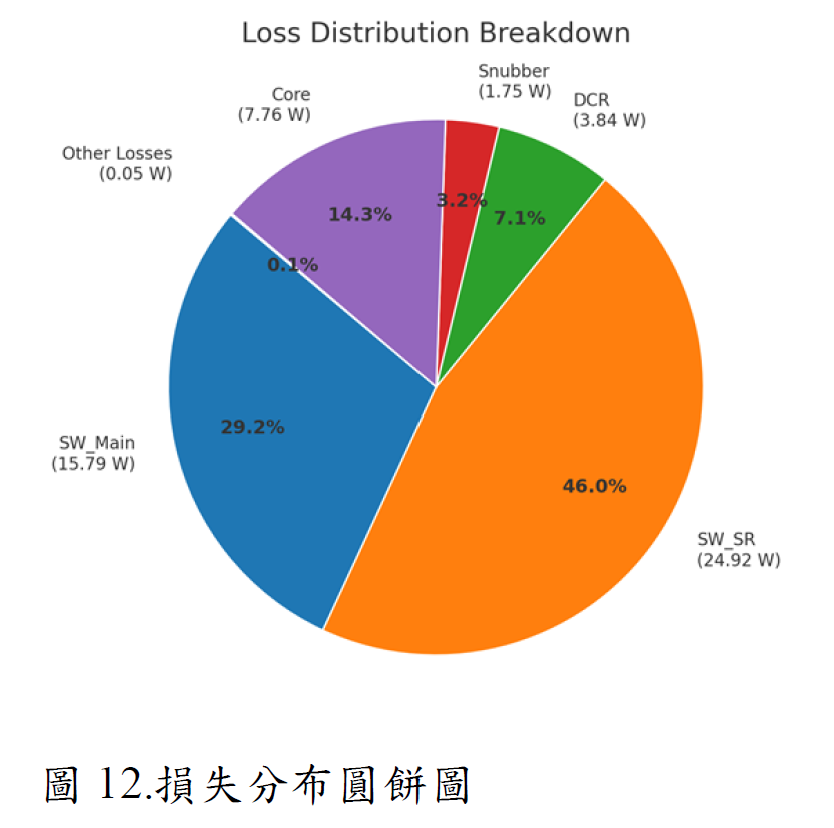
Figure: loss breakdown for the selected MOSFET (C3M0045065K) at the optimized operating point.
Why SIMBA fits this workflow
The paper uses SIMBA as the evaluation engine inside the BO loop:
- 3.3 kW synchronous buck model with closed-loop control
- MOSFET / sync rectifier / inductor / capacitor / snubber included
- each BO candidate (device, frequency, turns) is simulated for power, efficiency, and loss breakdown
- results update the GP surrogate for the next acquisition step
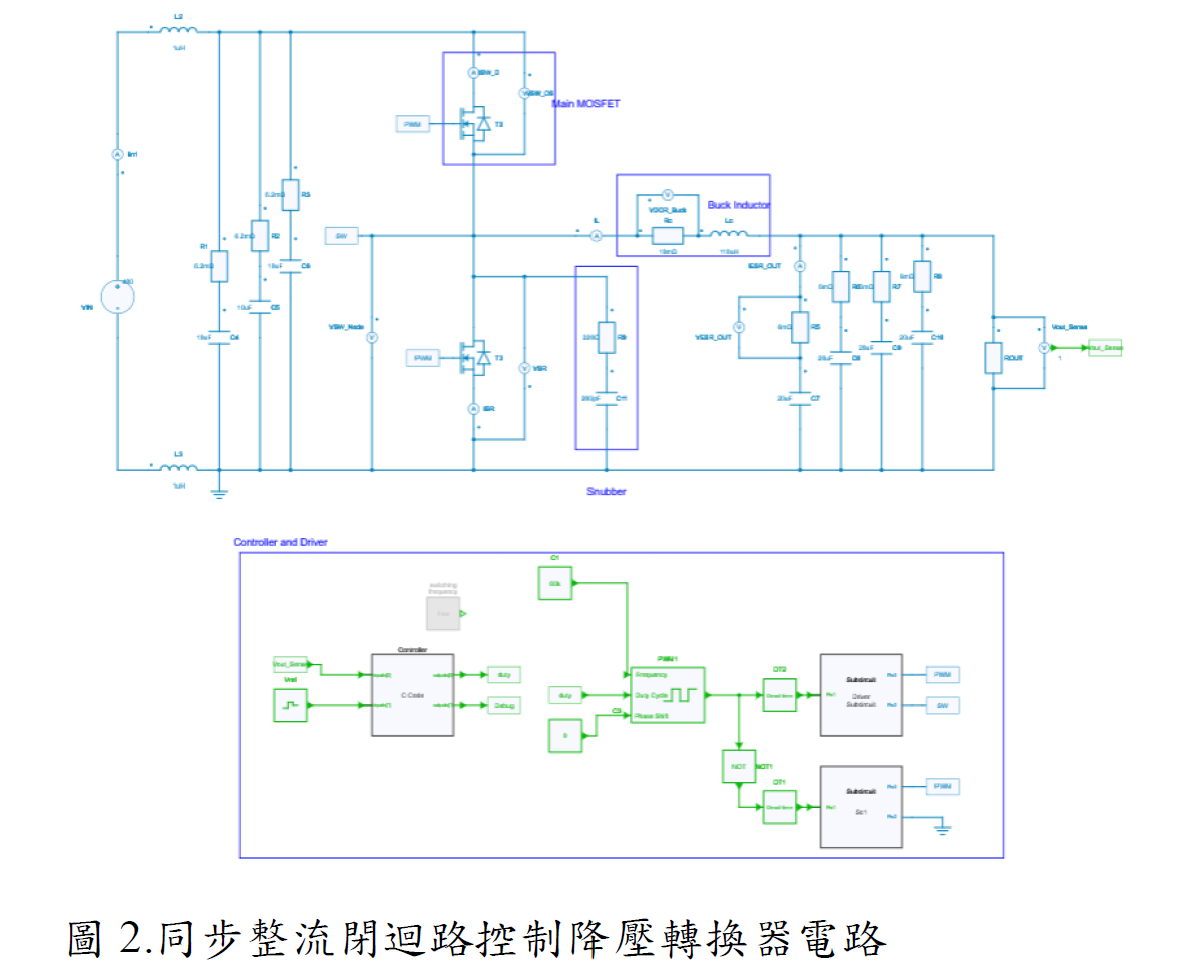
Figure: closed-loop synchronous buck converter in SIMBA, used as the evaluation engine inside the BO loop.
This is a practical pattern for design automation: datasheet-accurate discrete parts + sample-efficient optimization + circuit simulation.
Explore related SIMBA capabilities:
Who should read this paper
Useful if you work on:
- automated component selection for power converters
- Bayesian Optimization with discrete / categorical design variables
- datasheet-driven MOSFET and magnetics modeling
- buck / DC-DC efficiency optimization under real part constraints
- SIMBA-based design automation loops
Download and citation
Also available in Traditional Chinese.
Suggested citation:
N. T. Tung, C.-W. Tsai, and M.-H. Pong, “A New Method for Power Circuit Design Automation by Incorporating Discrete Components into Bayesian Optimization,” 46th Symposium on Electrical Power Engineering & 22nd Taiwan Power Electronics Conference, November 2025.
Key takeaways
- Real converter design is dominated by discrete commercial parts, not only continuous L/C values.
- Datasheet-parameter distance + normalization lets Bayesian Optimization search part catalogs sensibly.
- A 3.3 kW buck case reached >98% efficiency in ~30 SIMBA evaluations out of 1,920 combinations.
- The workflow is ready to extend to richer topologies and multi-objective design.
About this publication
This page highlights partner research that used SIMBA for automated power-electronics design. The scientific content belongs to the NTUST authors listed above.


